
Best Fish Finder for Jon Boat: 5 Units That Fit a Small Aluminum Hull
The best fish finder for a jon boat, matched to how you'll mount the transducer on an aluminum transom, power it, and read it from the tiller. 5 picks from $180.
Affiliate Disclosure: This article contains affiliate links. As an Amazon Associate we earn from qualifying purchases, at no extra cost to you. We only recommend gear we would genuinely use ourselves.
For most jon boats, the best fish finder is the Garmin Striker Vivid 4cv (about $190–$200): its GT20-TM transducer ships with both transom and trolling-motor mounting hardware, and it has GPS for marking spots. If you just want to see the bottom for less, the Humminbird PiranhaMAX 4 DI (about $180–$190) adds down imaging but no GPS. If you fish big water and want side imaging, step up to the Garmin Striker Vivid 7sv (about $520).
This guide is research-based. We compared manufacturer specifications and current retailer listings for each unit and read owner discussions about mounting transducers on aluminum hulls. We haven't installed or fished these units ourselves. The star ratings are our research scores, not test results.
Best Fish Finders for Jon Boats: Quick Comparison
| Product | Rating | Price | Best for | Link |
|---|---|---|---|---|
| Garmin Striker Vivid 4cv | 4.5/5 | ~$190–$200 | Best overall: GPS, transom + trolling-motor mounts | Check price |
| Humminbird PiranhaMAX 4 DI | 4.2/5 | ~$180–$190 | Budget pick with down imaging, very low power draw | Check price |
| Lowrance Eagle 5 SplitShot | 4.3/5 | ~$300–$360 | Preloaded US inland lake charts | Check price |
| Humminbird Helix 5 CHIRP GPS G3 | 4.1/5 | ~$350–$400 | Strong 2D CHIRP sonar plus AutoChart Live mapping | Check price |
| Garmin Striker Vivid 7sv | 4.4/5 | ~$520 | Side imaging on a screen big enough to read it | Check price |
- Garmin Striker Vivid 4cv4.5/5
- Price
- ~$190–$200
- Best for
- Best overall: GPS, transom + trolling-motor mounts
- Humminbird PiranhaMAX 4 DI4.2/5
- Price
- ~$180–$190
- Best for
- Budget pick with down imaging, very low power draw
- Lowrance Eagle 5 SplitShot4.3/5
- Price
- ~$300–$360
- Best for
- Preloaded US inland lake charts
- Humminbird Helix 5 CHIRP GPS G34.1/5
- Price
- ~$350–$400
- Best for
- Strong 2D CHIRP sonar plus AutoChart Live mapping
- Garmin Striker Vivid 7sv4.4/5
- Price
- ~$520
- Best for
- Side imaging on a screen big enough to read it
Prices are approximate, from retailer and manufacturer listings checked in October 2026. Bundles change often, so confirm the exact part number before you buy. New to fish finders? Our guide to choosing a fish finder explains sonar types, GPS and screen sizes in more depth.
What Matters on a Jon Boat (and Why Generic Lists Miss It)
A jon boat isn't a bass boat or a kayak. Three things decide which fish finder works on one:
- How the transducer meets an aluminum transom. The transducer has to sit in clean water below the hull. Riveted aluminum hulls throw off air bubbles, so placement matters more than it does on a smooth fiberglass hull.
- How you power it. Most jon boats have one battery for the trolling motor or starting the outboard. A low-draw unit can share it or run off a small separate battery.
- Where you'll look at it. On a tiller jon boat you're sitting at the stern, so the screen sits close to you. A 4–5 inch screen is readable at that distance. Side imaging is the exception: it needs a bigger screen to be useful.
Every unit below ships with a transom-mount transducer, the standard choice for an open aluminum hull. Plan on mounting it on the transom or on a trolling motor.
#1 Best Overall: Garmin Striker Vivid 4cv
The Striker Vivid 4cv (part number 010-02550-00 or -01, depending on the listing) is the most flexible jon boat unit at its price. Both retailer listings we checked say the included GT20-TM transducer comes with transom and trolling-motor mounting hardware. You can start with it on the transom and move it to the trolling motor later without buying another transducer.
It pairs traditional CHIRP sonar (77/200 kHz) with ClearVü, Garmin's down-imaging mode, which draws structure like brush and rock as a picture instead of arches. It also has a high-sensitivity GPS and Quickdraw Contours, which builds your own 1-foot contour map as you drive. That's useful on the small lakes and river backwaters where jon boats spend their time and published charts are thin.
Power is easy: Garmin's manual lists a 12–20V DC input and a 3A fuse, and one retailer gives a typical draw of 0.40A. The screen is 4 inches at 480 × 272 pixels, which is fine from the tiller seat but small for splitting the screen between sonar and map.
Pros
- GT20-TM transducer includes transom and trolling-motor mounting hardware
- CHIRP sonar plus ClearVü down imaging
- Built-in GPS with Quickdraw Contours mapping
- Low power draw for a single shared battery
Cons
- 4-inch, 480 × 272 screen is cramped in split-screen view
- No preloaded lake charts (you build your own with Quickdraw)
- No side imaging
#2 Best Budget: Humminbird PiranhaMAX 4 DI
The PiranhaMAX 4 DI (part number 410160-1) is the cheapest way onto this list that still gives you down imaging. Humminbird lists a 4.3-inch color screen (480 × 272), dual-beam sonar plus down imaging at 200/455 kHz, and the XNT 9 DI T transom transducer in the box.
Its standout spec for a small boat is power: Humminbird lists a 180 mA (0.18A) draw at 10.8–20V. That's less than half the Garmin's typical draw, so it's the easiest unit here to run off a small battery or alongside a trolling motor.
The trade-off is no GPS. You can't drop a waypoint on a brush pile and find it again. If you fish the same small water every weekend and navigate by landmarks, that may not matter. If you want to mark spots, spend the extra few dollars on the Striker Vivid 4cv.
Pros
- Down imaging and dual-beam sonar at the lowest price here
- Very low 180 mA power draw
- Transom transducer included
Cons
- No GPS, waypoints or mapping
- Down imaging depth listed at 320 ft (plenty for most jon boat water)
- Transducer is transom-only in the box
#3 Best for Lake Maps: Lowrance Eagle 5 with SplitShot HD
If you'd rather launch with contour lines already on the screen, the Eagle 5 is the pick. The combo we checked (part number 000-16111-001) comes with C-MAP inland charts covering 17,000+ US lakes, plus Genesis Live for recording your own contours.
The SplitShot HD transducer combines wide-angle high CHIRP sonar with DownScan Imaging, and it ships with a transom bracket. The 5-inch IPS screen is listed as viewable from all angles, even through polarized glasses, which helps when you're glancing at it from the side of a tiller seat.
Power draw wasn't stated on either listing we checked, so check Lowrance's spec sheet if you're sizing a small battery. Prices vary with the chart bundle: about $300 for the inland-lakes version, more for C-MAP Discover bundles.
Pros
- Preloaded C-MAP charts for 17,000+ US lakes (inland bundle)
- CHIRP plus DownScan in one transom transducer
- IPS screen readable through polarized glasses
Cons
- Several bundles with different charts and prices; check the part number
- No side imaging with the SplitShot transducer
- Power draw not listed on the retailer pages we checked
#4 Best 2D Sonar With Mapping: Humminbird Helix 5 CHIRP GPS G3
The Helix 5 CHIRP GPS G3 (part number 411660-1) is for anglers who care most about traditional sonar: seeing fish as arches and reading bottom hardness. Humminbird lists Dual Spectrum CHIRP with wide and narrow modes, an 800 × 480 five-inch screen, and the XNT 9 HW T transom transducer.
It includes internal GPS, the Humminbird Basemap and AutoChart Live for recording your own depth maps. It also accepts LakeMaster and Navionics charts if you want more detail later.
Note what it doesn't have: this version is 2D CHIRP only, with no down imaging. Humminbird sells a separate Helix 5 CHIRP DI GPS G3 if you want both. Humminbird lists a 615 mA draw, the highest published figure among the 4–5 inch units here, though still easy for a modest battery to cover for a day.
Pros
- Sharp 800 × 480 five-inch screen
- Dual Spectrum CHIRP with wide and narrow modes
- GPS with Basemap and AutoChart Live
- Works with LakeMaster and Navionics charts
Cons
- No down imaging on this version
- Highest price of the 4–5 inch units
- 615 mA draw, the highest published figure among the small screens here
#5 Best Side Imaging: Garmin Striker Vivid 7sv
Side imaging shows structure off each side of the boat, so you can scan a creek channel or weed edge without driving over it. It needs screen space to be readable, which is why the pick here is the 7-inch Striker Vivid 7sv (part number 010-02553-00) rather than a 5-inch unit.
Both retailer listings we checked include the GT52HW-TM transducer and a tilt/swivel mount, and list CHIRP traditional sonar plus ClearVü down imaging and SideVü side imaging, with GPS and Quickdraw Contours. One listing gives maximum depths of 800 ft (traditional) and 500 ft (ClearVü and SideVü), far more than jon boat water needs.
At about $520 it costs more than twice as much as the 4-inch picks, and the bigger head unit takes more deck space. It's worth it if you fish large reservoirs or rivers where finding structure is the hard part.
Pros
- SideVü side imaging plus ClearVü and CHIRP
- 7-inch screen is large enough for side imaging
- GPS with Quickdraw Contours
Cons
- About $520, the most expensive pick
- Larger head unit to fit on a small boat
- Overkill for ponds and small creeks
How to Mount a Transducer on an Aluminum Jon Boat Transom
Mount the transducer on the transom low enough that it sits in solid water below the hull, away from rivets and the outboard's propeller. Most poor readings on jon boats come from placement, not the unit.
Owners on iboats and similar forums describe the same patterns:
- Keep it below the hull line. A transducer that sits at or above the bottom of the hull loses the bottom once the boat moves.
- Stay clear of rivets and ribs. Water flowing over rivets and hull seams picks up air bubbles, and bubbles block sonar. Pick a flat, smooth section of the transom.
- Stay away from the prop. Prop wash is full of bubbles. Check your transducer's installation instructions (for example, Garmin's transom-mount transducer instructions) for the exact clearance and which side of the motor to use.
- Don't want to drill? A common forum workaround is to bond a plastic mounting board to the transom with marine adhesive and screw the transducer bracket into the board instead of the aluminum. Clamp-on boards and trolling-motor mounts are other no-drill options.
If you run a bow-mount trolling motor, mounting the transducer on the trolling motor puts it in clean water, away from the outboard. Of the picks above, the Garmin Striker Vivid 4cv is the one whose listings explicitly include trolling-motor hardware.
How to Power a Fish Finder on a Jon Boat
All five units run on 12V boat power. You have two simple options:
- Share the trolling motor or starting battery. Run a fused lead straight to the battery. Garmin's Striker Vivid manual specifies a 3A fast-acting fuse; use what your unit's manual says.
- Use a small dedicated battery. Runtime is roughly the battery's amp-hours divided by the unit's draw. On paper, a 7Ah battery runs the PiranhaMAX 4 DI (0.18A) for well over a day of fishing, and the Helix 5 (0.615A) for about 11 hours. Real-world runtime is lower, because you won't use the full rated capacity of a lead-acid battery, and backlight settings change the draw.
A small self-contained battery also lets you take the unit onto the ice in winter. Our guide on whether a regular fish finder works for ice fishing covers which ice kits fit Garmin, Humminbird and Lowrance units and what battery each needs.
Which Sonar Type Do You Need on a Jon Boat?
For creeks, ponds and shallow river backwaters, 2D sonar plus down imaging covers almost everything. That's the Striker Vivid 4cv, PiranhaMAX 4 DI or Eagle 5.
- 2D sonar shows fish as arches and tells you bottom hardness. Every unit here has it; all except the PiranhaMAX 4 DI (listed as dual-beam) use CHIRP, which sweeps a range of frequencies for clearer separation.
- Down imaging (Garmin ClearVü, Humminbird DI, Lowrance DownScan) draws a picture-like view of what's directly below. It makes stumps, brush and rock easy to identify.
- Side imaging (Garmin SideVü) scans out to each side. It's most useful on big water and needs a 7-inch or larger screen.
- GPS lets you mark spots and record contours. On a jon boat that fishes the same small water repeatedly, it's the most useful feature after the sonar itself.
Frequently Asked Questions
Can I use a kayak fish finder on a jon boat?
Yes. Kayak-sized units like the Striker Vivid 4cv and PiranhaMAX 4 DI are the same products sold for small boats, and their transom transducers fit a jon boat transom. The main difference is mounting: on a jon boat you'll use the transom bracket instead of a scupper or arm mount. Our best fish finder for kayak guide covers the kayak side.
Why does my fish finder lose the bottom when the jon boat is moving?
Almost always placement. The transducer is either sitting too high, so it comes out of the water when the hull planes, or it's behind rivets or in prop wash, where air bubbles block the signal. Lower it and move it to a smooth section of the transom away from the motor.
Do I have to drill holes in my jon boat to mount a transducer?
No. Options include bonding a plastic board to the transom and mounting the bracket to that, clamp-on transducer boards, or mounting the transducer on a trolling motor shaft. Owners on aluminum-boat forums often report that temporary brackets and suction cups read fine at rest but lose the bottom under way, so a solid mount is worth the effort.
Is side imaging worth it on a small jon boat?
Usually not, unless you fish large lakes or rivers. Side imaging needs a bigger screen (about 7 inches) to read well, and on small waters you can cover the area with down imaging and a few passes.
What size fish finder screen do I need for a jon boat?
A 4–5 inch screen is enough for 2D sonar and down imaging when you're sitting near it at the tiller. Go to 7 inches if you want side imaging or a usable split screen of sonar and map.
The Bottom Line
Get the Garmin Striker Vivid 4cv if you want one unit that does it all on a small aluminum hull: down imaging, GPS, and a transducer that mounts on the transom now and the trolling motor later. Choose the Humminbird PiranhaMAX 4 DI if the budget is tight and you don't need GPS, the Lowrance Eagle 5 if preloaded lake charts matter, and the Garmin Striker Vivid 7sv only if you fish big water where side imaging pays off.
Keep reading
Can You Use a Regular Fish Finder for Ice Fishing? (Kayak Units Too)
Yes. A regular or kayak fish finder works on the ice with an ice transducer and a battery. Here's which ice kit fits Garmin, Humminbird, Lowrance and Deeper units.
How to Choose a Fish Finder: A Small-Boat Buyer's Guide by Boat, Sonar and Budget
How to choose a fish finder for a kayak, canoe, jon boat or the ice: transducer mounting, sonar types, screen size, GPS, power draw and what each budget buys.
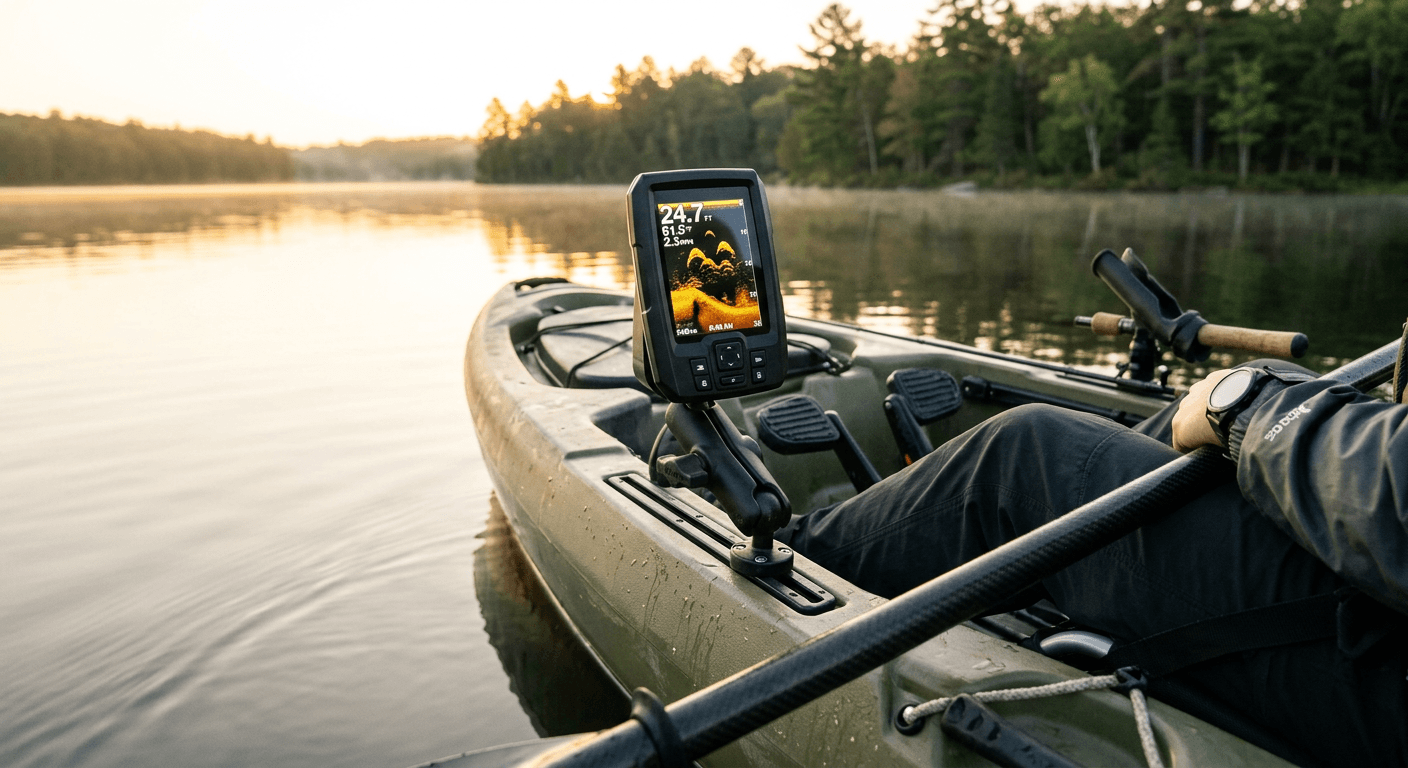
Best Fish Finder for Kayak: 6 Units Compared for 2026
The best fish finders for kayak fishing — from the Garmin Striker 4 budget pick to the Deeper PRO+ castable sonar. Buyer's guide, mounting tips, and honest reviews.