Affiliate Disclosure:This article contains affiliate links. If you purchase through our links, we may earn a small commission at no extra cost to you. We only recommend gear we've tested or would genuinely use ourselves.
buying guide • May 14, 2026 • 16 min read · The Bite Intel Team
Kayak Fishing Safety Gear Checklist: 12 Must-Haves Before You Launch
Kayak fishing safety gear checklist: 12 must-haves, USCG legal requirements, and fishing-specific items most guides miss — with specific brand picks.
Kayak Fishing Safety Gear Checklist: 12 Must-Haves Before You Launch
Most kayak fishing safety guides list a PFD and a whistle, then call it done. That works for a casual flatwater paddle — it doesn't work when you're two miles offshore at 5 AM fighting a 12-pound striper while a center console comes around the point doing 30 knots.
This kayak safety checklist is built for anglers, not just paddlers. Every item here addresses fishing-specific scenarios that generic checklists ignore: embedded hooks in your hand, a paddle floating away while you fight a fish, getting run over by a wake boat because your hull is flat black and invisible at dawn.
Before we get into it: according to the U.S. Coast Guard's Recreational Boating Safety Statistics, more than 80% of kayak drowning victims were not wearing a life jacket at the time of the accident. That number has barely moved in a decade. The gear exists. Wearing it and using it is the gap.
1. A Fishing-Specific PFD — Not Just Any Life Jacket
A fishing PFD is cut differently than a standard kayak PFD, and the difference matters every single cast. The right kayak fishing life jacket sits low across the chest, keeps foam away from your casting arm, and has pockets sized for pliers, a lure, or a small flashlight.
The Onyx MoveVent Dynamic ($80) is the benchmark. It has a ventilated mesh back that eliminates the sweat problem on summer days, front pockets with clip points for tackle, and a low-profile cut that stays out of your backcast. The Stohlquist Edge ($100) runs slightly higher in the torso and is preferred by anglers fishing rougher coastal water who want more buoyancy.
What to skip: the standard foam kayak PFD from the big-box store. It's built for forward-leaning paddlers, not anglers. The thick chest panel wraps around your casting arm on every single throw.
Check Onyx MoveVent Dynamic on AmazonWarning
2. Safety Whistle — USCG Required, Often Forgotten
The U.S. Coast Guard requires every kayak to carry a sound-producing device. A whistle is the right choice: no batteries, no charging, no moving parts to fail, audible up to a quarter mile in open water.
Pealess whistles only. A pea whistle — the kind with a small ball bearing inside — clogs in salt water, freezes up in cold weather, and fails when you need it most. The Fox 40 Classic ($7) and the Fox 40 Micro ($6) are both pealess, Coast Guard-approved, and loud enough to be heard over engine noise and wave slap.
Clip it to your PFD zipper pull or a D-ring on the shoulder strap. If it's in a dry bag it's useless.
Check Fox 40 Pealess Whistle on Amazon3. Visibility Gear — How to Not Get Run Over
Kayaks are low, dark, and nearly invisible to motorboat operators at dawn and dusk — which is exactly when serious kayak anglers are on the water. Forum discussions among open-water kayak fishers consistently rank boat strikes as their top safety concern, and with good reason.
The minimum effective setup is a tall visibility flag on a 6-foot pole plus a white 360-degree navigation light for low-light operation. The YakAttack VisiCarbon Pro (~$60) is the gold standard: the telescoping carbon fiber mast collapses to 14 inches for transport, deploys to 48 inches, and the built-in LED runs 100 hours on three AA batteries. If budget is tight, any telescoping kayak safety flag kit under $30 that comes with a separate suction-cup LED nav light does the job.
For about $8, add two strips of 3M Scotchlite reflective tape along the hull sides. It makes you visible in any set of headlights or spotlight at range. Cheap insurance.
Check Kayak Safety Flags on AmazonFor dedicated night and pre-dawn fishing setups, see our full breakdown of the best kayak fishing lights for night fishing.
4. Emergency Communication — Why Your Phone Is Not Enough
Phones fail on open water in ways that cost lives: dead zones two miles from shore, wet hands dropping a device over the side, a battery that died faster than expected in the cold. You cannot rely on a cell phone as your only emergency communication.
The Standard Horizon HX40 handheld VHF marine radio (~$100) floats, submersion-rated to JIS-4 standards, and transmits on Channel 16 — the international distress frequency monitored by the U.S. Coast Guard and every commercial vessel within range. In a capsize scenario where you've lost your phone, Channel 16 still has ears.
For fishing exclusively on small inland lakes with reliable cell coverage: a fully charged phone in a waterproof case is an acceptable secondary. For anything tidal, coastal, or more than one mile from shore, the VHF is non-negotiable safety gear for kayak fishing.
Check Standard Horizon HX40 on AmazonTip
5. Dress for the Water Temperature, Not the Air
Cold water immersion is the most underestimated threat in kayak fishing. According to the National Center for Cold Water Safety, water below 60°F triggers cold shock reflexes within 30 seconds of immersion — involuntary gasping, hyperventilation, and rapid loss of swimming ability. This happens before hypothermia. You can inhale water and drown in the time it takes to take three breaths.
The rule every safety guide agrees on: dress for the water you'd swim in, not the air you're fishing in.
- Below 50°F water: Drysuit with base layers, non-negotiable
- 50–60°F water: 3mm wetsuit minimum, drysuit preferred
- 60–70°F water: Wetsuit optional, quick-dry synthetic layers required
- Above 70°F water: Normal fishing clothes, but avoid cotton — it kills in cold water by wicking heat 25x faster than wool or synthetic
April and May are the most dangerous months for freshwater kayak anglers. Air temperatures hit the 60s and 70s, but reservoirs and rivers fed by snowmelt run 45–55°F. Dress for the water temperature that would kill you if you fell in, not the air temperature that makes the fishing comfortable.
For a full seasonal breakdown of what to wear, see our what to wear kayak fishing guide.
Warning
6. Fishing-Specific Safety Items Most Guides Skip
Generic safety guides stop at PFD, whistle, and light. That's the legal minimum — not the realistic minimum for someone running four rods, an anchor trolley, and a fish stringer off the stern. These four items are specific to kayak fishing scenarios and almost never appear in competitor checklists.
| Product | Rating | Price | Best For | Link |
|---|---|---|---|---|
| Kayak Paddle Leash | 4.5/5 | $20 | Keeps your paddle with you when you drop it to fight a fish | Check Price |
| Fish Hook Remover Tool | 4.7/5 | $12 | Safely removes embedded hooks without touching them | Check Price |
| Gerber River Shorty Knife | 4.6/5 | $30 | Cuts anchor lines and entanglements instantly | Check Price |
| Cut-Resistant Fishing Gloves | 4.4/5 | $25 | Handles fish with sharp gill plates and spines safely | Check Price |
The paddle leash connects your paddle to the kayak via a coiled tether. When a fish runs and you drop the paddle to grab the rod, your paddle stays with you instead of floating downwind. Losing your paddle a mile from shore is a rescue call.
The hook remover is a stainless locking tool — typically 8–10 inches — that grips the hook bend and backs it out without your hand ever touching the barb. Embedded treble hooks in your palm on a moving kayak 400 yards from shore have ended many fishing trips and a few lives.
The knife clips to your PFD, not a tackle bag. Entanglement with anchor rope, fish stringer, or tangled fishing line around your feet or hands can hold you underwater. A fixed-blade knife on your chest means you can cut free in three seconds. The Gerber River Shorty has a sheath with a clip specifically designed for PFD mounting.
7. Dry Bag for Emergency Supplies
Everything that saves your life in an actual emergency — phone, backup batteries, dry base layers, first aid kit, flare — needs to live in a waterproof dry bag, not a tackle box or hull compartment with a leaky hatch.
The NRS Tuff Sack 5L ($30) is the standard choice: roll-top seal, welded TobaTex construction, floats when closed, and fits neatly in a day hatch or bungee area. The SealLine Baja Dry Bag 5L ($25) is a solid budget alternative for calmer freshwater use.
Size the bag for your emergency gear only — this is not a general gear bag. Phone, battery pack, compact first aid kit, emergency mylar blanket, VHF radio. Everything else goes in your regular tackle storage.
Check NRS Tuff Sack on AmazonFor full sizing and placement advice, see our kayak fishing dry bag buying guide.
8. First Aid Kit — Configured for Fishing Injuries
A standard 100-piece first aid kit from the drugstore is built for skinned knees and headaches. A kayak fishing first aid kit covers those plus the injuries that actually happen on the water: fish spine punctures, treble hook embeds, cuts from gill plates, and sun-related heat illness.
Pack these fishing-specific additions in a waterproof case alongside standard supplies:
- Forceps (6-inch): Backup hook removal when the Hookout Pro can't reach the angle
- Wound irrigation syringe: Fish mouth bacteria (Vibrio, Aeromonas) moves fast in puncture wounds — flush immediately with clean water
- Adhesive butterfly closures: For gashes from fin spines or a dropped lure on a slippery deck
- Broad-spectrum antibiotic ointment: Apply immediately to any puncture wound from a fish
- Emergency mylar blanket: Hypothermia response for cold-water immersion survivors
The Adventure Medical Kits Ultralight/Watertight 0.9 (~$40) comes pre-packed in a waterproof submersible bag and fits in any day hatch.
9. The Float Plan — The Free Safety Item Most Anglers Skip
A float plan is the highest-leverage safety item on this entire list, costs nothing, and is skipped by the overwhelming majority of solo kayak anglers. Here is what a float plan is: a written record of where you're going and when you'll be back, left with someone who commits to calling 911 if they don't hear from you by a specific time.
Leave it with a spouse, family member, or trusted friend — not someone who "might check in." Someone who will absolutely call the Coast Guard or county sheriff at 3 PM if you haven't texted by then.
Your float plan should include:
- Put-in location with GPS coordinates or address
- Planned fishing area and approximate distance from shore
- Your kayak: make, model, color, any identifying markings
- Expected return time — specific, not "afternoon"
- Your vehicle: make, model, color, license plate at the launch
- VHF radio channel (Channel 16 for coastal, monitor local channel for inland)
- Emergency contact: one person on land, one person who knows the area
The BoatUS Foundation provides a free float plan form you can fill out and email in 60 seconds. Use it every time you fish solo.
Tip
10. Self-Rescue Skills
Knowing how to re-enter your kayak after a capsize is not instinct — it's a practiced skill. The first time you attempt a wet exit should not be in 52°F water half a mile from shore.
Find a calm, shallow, warm-water spot and practice three things before you fish any open water:
- Wet exit: Deliberately capsize and get clear of the cockpit without panic. Know what it feels like and how long it takes you specifically.
- Re-entry: Get back onto a sit-on-top from the water without a dock or assistance. This requires more upper body strength than most anglers expect.
- Staying with the hull: If you cannot re-enter, know the correct response — stay with the kayak, signal with your whistle, and wait. A floating kayak is visible to rescuers. A swimmer is not.
Anglers who fish solo regularly should practice these skills at least once per season, particularly before the first spring launch when water is coldest.
Frequently Asked Questions
Is wearing a PFD required by law for kayak fishing?
Every state requires a USCG-approved PFD to be on board for each person on a kayak. Most states for adults require it to be on board and accessible, not necessarily worn — but children typically must wear it at all times. Regardless of your state's legal minimum, we recommend wearing it on every trip. You cannot put it on after you've capsized.
What safety gear do I actually need vs. what's nice to have?
Legal minimum: USCG-approved PFD, a sound-producing device (whistle or horn), and a 360-degree white light for operation between sunset and sunrise. Realistic minimum for any kayak fishing beyond a sheltered pond: add a VHF marine radio, a paddle leash, a float plan, and appropriate clothing for water temperature. Everything else on this list scales with how far from shore and how rough the conditions.
How far from shore should I fish from my kayak?
Most experienced kayak fishing guides use a 1-mile-from-shore baseline for recreational fishing on calm, familiar water. On open coastal water or in variable conditions, that shrinks to half a mile or less. The useful question isn't distance but rescue time: if something goes wrong right now, how long until someone reaches you? Factor in current, wind, wave height, and whether you have line-of-sight radio contact.
What do I do if I flip my kayak while fishing?
Stay with the kayak. A capsized hull still floats and is dramatically easier for rescuers to spot than a swimmer. If your PFD is on (it should be), you're already buoyant. Use your whistle immediately. Attempt re-entry only if you've practiced and you're not in surf or moving current. If you cannot re-enter, hold the hull, signal continuously, and wait for help.
Do I need a VHF radio for kayak fishing or will my phone work?
For small, sheltered inland lakes with reliable cell coverage: a fully charged phone in a waterproof case is sufficient as a secondary. For coastal fishing, tidal estuaries, large reservoirs, or any situation where you're beyond reliable cell range: a handheld VHF radio is strongly recommended. Cell phones don't work in dead zones, fail faster in cold temperatures, and cannot transmit on Channel 16 — the universal maritime emergency frequency monitored by the U.S. Coast Guard.
The honest short version of this safety gear checklist: wear your PFD, clip your whistle, leave a float plan. Those three actions address the most common fatal failures in kayak fishing accidents. They're free or nearly free, require no skill to deploy, and work on every body of water. Layer in the VHF radio, the visibility gear, and the fishing-specific items as your range and conditions grow more demanding.
For a complete setup walkthrough — safety gear included — see our kayak fishing setup for beginners guide.
Related Posts
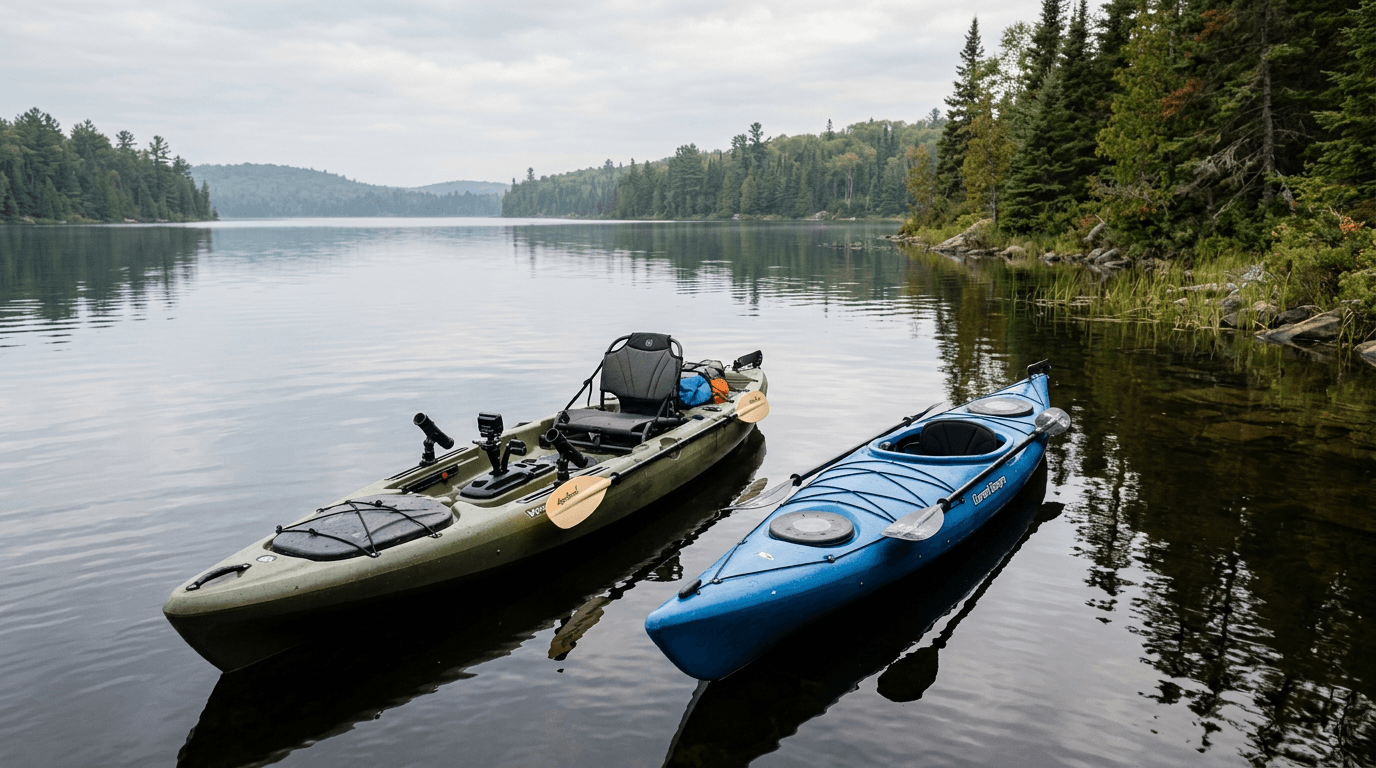
Angler Kayak vs Regular Kayak: 7 Key Differences That Change How You Fish
Angler kayak vs regular kayak — the real functional differences in stability, storage, speed, and cost. Plus whether your regular kayak is worth converting.
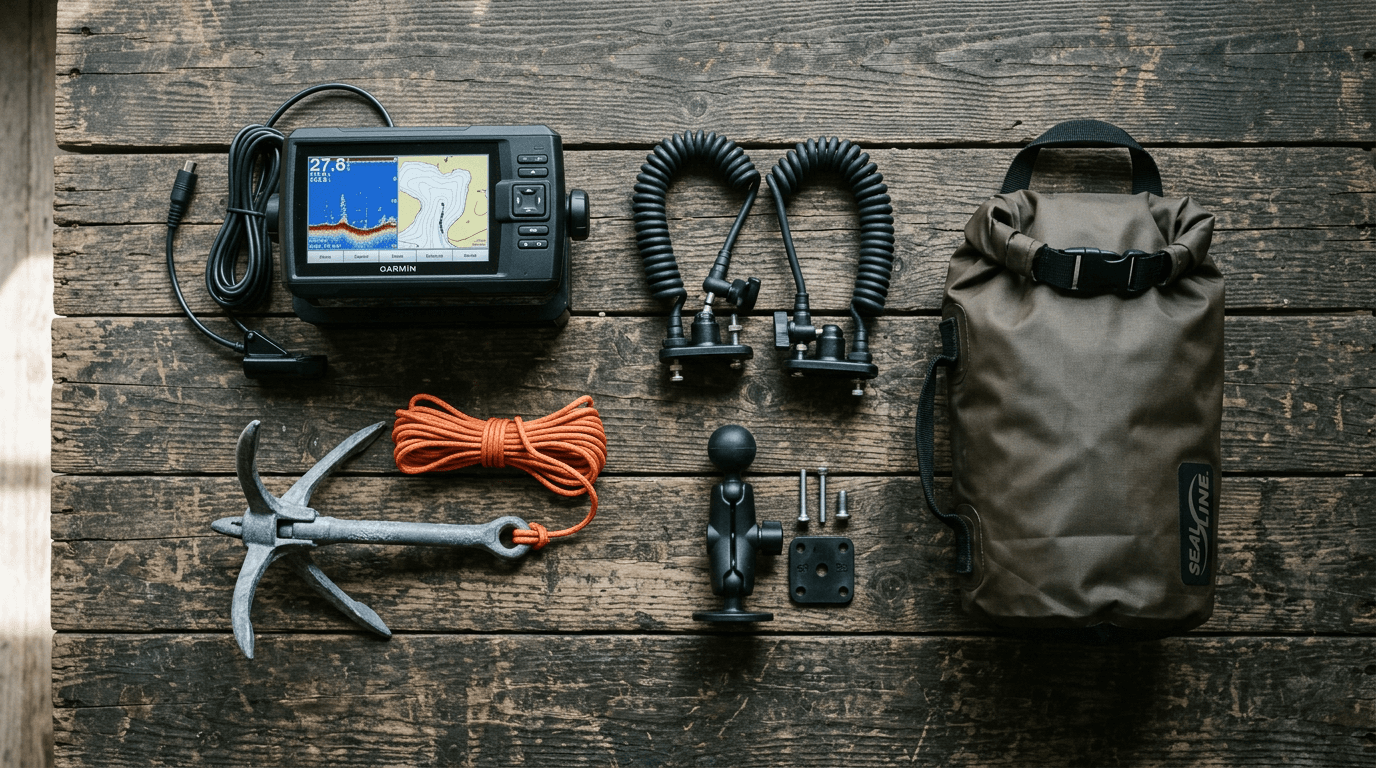
Fishing Kayak Attachments: The Complete Rigging and Mounting Guide
Best fishing kayak attachments explained — track systems, rod holders, fish finder mounts, anchors, and storage. What to buy, where to mount it, and how.
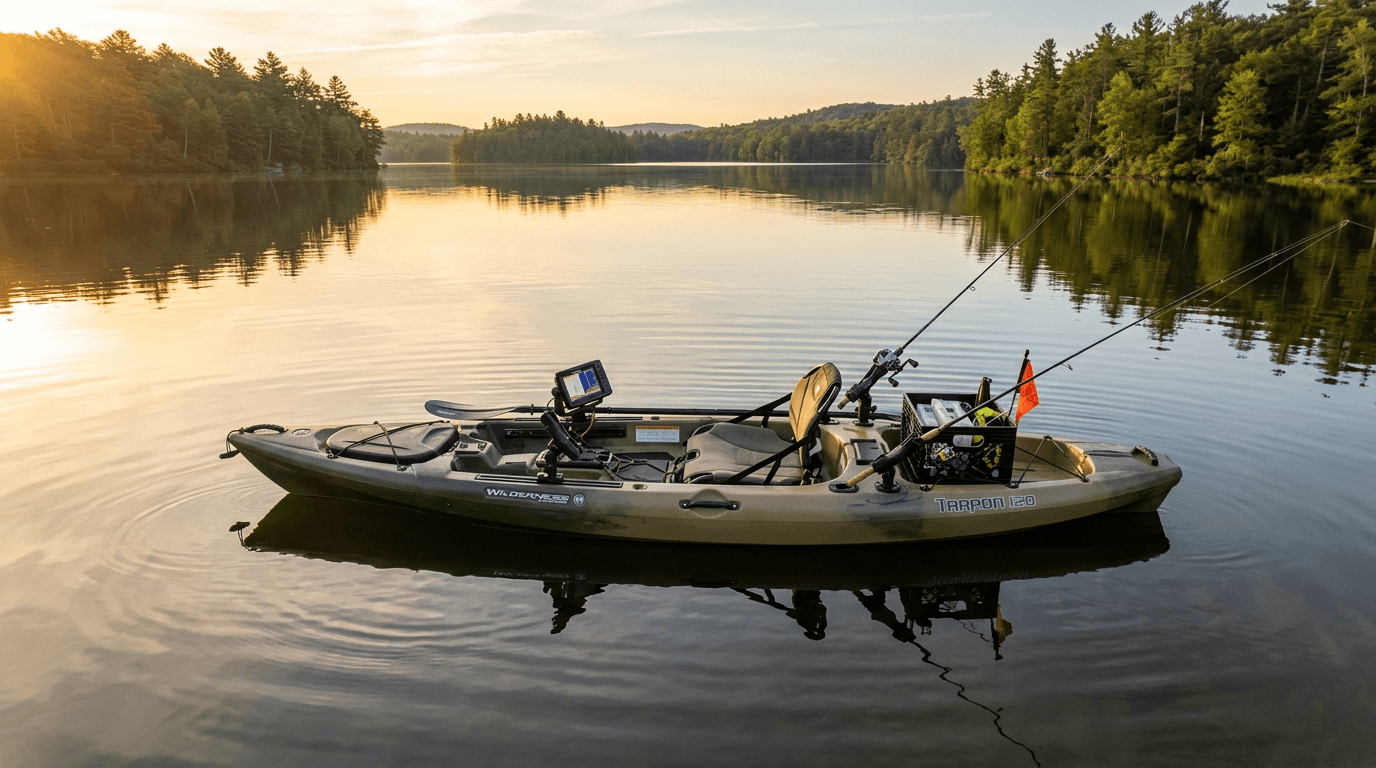
Kayak Fishing Accessories: What to Buy First, What to Skip, and How to Build the Right Setup
Which kayak fishing accessories are worth buying? We break down every category by priority and budget — rod holders, anchors, fish finders, and more.