
Best Fish Finder for Pontoon Boat: 4 Picks That Reach the Helm
The best fish finder for a pontoon boat, matched to a 20-foot transducer cable run, a mount on the pontoon log and a helm-sized screen. 4 picks compared.
Affiliate Disclosure: This article contains affiliate links. As an Amazon Associate we earn from qualifying purchases, at no extra cost to you. Our picks are based on research, not sponsorship.
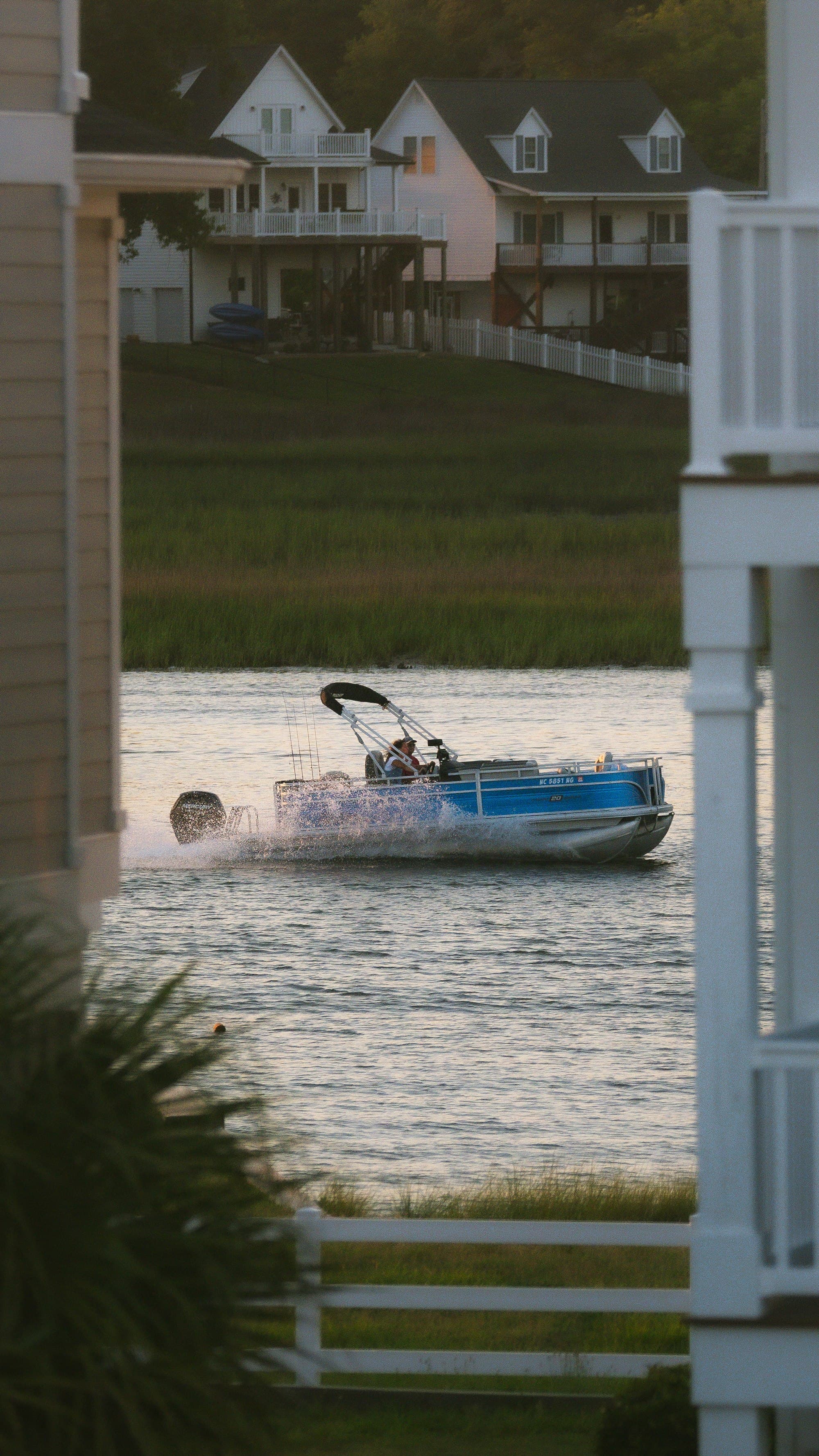
Photo by Casey Calhoun on Unsplash
For most pontoon boats, the best fish finder is the Garmin Striker Vivid 7sv. It has a 7-inch screen you can read from the helm, side imaging for scanning wide flats, and a low 0.67A draw. If you want lake maps on the screen from day one, get the Lowrance Eagle 9, which comes with C-MAP inland charts. For the most sonar detail, the Humminbird Helix 7 MSI GPS G4N adds MEGA side imaging.
On a pontoon, the hard part isn't picking sonar. It's getting the transducer into clean water at the back of a pontoon log and running its cable to a helm that may be 15–20 feet away. Each of the four units below ships with a transom-mount transducer, and we list the cable length for every one where we could confirm it.
This guide is research-based. We compared manufacturer specifications, owner's manuals and current retailer listings, and read pontoon owners' forum threads about transducer placement. We haven't installed or fished these units ourselves. The star ratings are our research scores, not test results.
Best Fish Finders for Pontoon Boats: Quick Comparison
| Product | Our score | Price tier | Best for | Link |
|---|---|---|---|---|
| Garmin Striker Vivid 7sv | 4.5/5 | $ | Best overall: 7-inch screen, side imaging, low power draw | Check price |
| Lowrance Eagle 9 TripleShot HD | 4.3/5 | $$ | Biggest screen, preloaded US inland lake charts | Check price |
| Humminbird Helix 7 MSI GPS G4N | 4.4/5 | $$$ | Most detailed side imaging, networking, in-dash option | Check price |
| Garmin ECHOMAP UHD2 74sv | 4.2/5 | $$$ | Chartplotter with touchscreen and LiveScope upgrade path | Check price |
- Garmin Striker Vivid 7sv4.5/5
- Price tier
- $
- Best for
- Best overall: 7-inch screen, side imaging, low power draw
- Lowrance Eagle 9 TripleShot HD4.3/5
- Price tier
- $$
- Best for
- Biggest screen, preloaded US inland lake charts
- Humminbird Helix 7 MSI GPS G4N4.4/5
- Price tier
- $$$
- Best for
- Most detailed side imaging, networking, in-dash option
- Garmin ECHOMAP UHD2 74sv4.2/5
- Price tier
- $$$
- Best for
- Chartplotter with touchscreen and LiveScope upgrade path
Our score is our research rating, not an Amazon customer rating. Price tier compares the picks in this guide ($ lowest, $$$$ highest); check Amazon for the current price.
| Unit | Screen | Included transducer | Transducer cable | Typical draw (12V) |
|---|---|---|---|---|
| Garmin Striker Vivid 7sv | 7 in, 800 × 480 | GT52HW-TM (transom) | Not stated for the bundle version (see below) | 0.67A |
| Lowrance Eagle 9 TripleShot HD | 9 in IPS | TripleShot HD (transom) | 20 ft | Not confirmed |
| Humminbird Helix 7 MSI GPS G4N | 7 in, 1024 × 600 | XNT 9 HW MSI 150 T (transom) | 20 ft | 0.8A |
| Garmin ECHOMAP UHD2 74sv | 7 in touchscreen, 800 × 480 | GT54UHD-TM (transom) | 20 ft | 1.52A |
Specs come from the manufacturer and retailer pages named in each section, checked in October 2026. Bundles change, so confirm the part number before you buy. New to fish finders? Our guide to choosing a fish finder explains sonar types, GPS and screen sizes.
What Matters on a Pontoon (and What Generic Lists Skip)
Three things decide whether a fish finder works on a pontoon boat:
- Where the transducer goes. A pontoon has no single hull bottom. The transducer mounts on a bracket at the back of one pontoon log, set just below the log's lowest point, so it reads clean water instead of the turbulence the logs create.
- Whether the cable reaches the helm. Most transducers ship with about 20 feet of cable. On a pontoon, the run goes from the back of a log, up under the deck and forward to the console, so it can come up short. Pontoon owners on iboats report running out of transducer cable during installation.
- Whether you can read the screen from the helm. You sit back from the console on a pontoon, often with family moving around. A 7–9 inch screen is easier to read there than the 4–5 inch units that suit kayaks and jon boats.
Power is the easy part. Pontoons have a battery and usually a fused accessory circuit at the helm, and every unit here runs on 12V.
#1 Best Overall: Garmin Striker Vivid 7sv
The Striker Vivid 7sv (part number 010-02553-00 or -01, depending on the listing) gives you the most useful pontoon features for the money. Garmin's spec sheet lists a 7-inch, 800 × 480 screen, traditional CHIRP sonar, ClearVü down imaging and SideVü side imaging, integrated GPS and Quickdraw Contours, which records your own 1-foot contour maps as you drive.
Side imaging matters more on a pontoon than on a small boat. Pontoons often fish big, open flats and weed lines, and side imaging lets you scan them on one pass instead of driving over every spot. The 7-inch screen is large enough to read a side imaging view from the helm.
Power draw is low: Garmin's spec sheet lists 0.67A at 12V, and the owner's manual gives a 12–20V input and a 3A fast-acting fuse. The retailer listings include the GT52HW-TM transducer and a tilt/swivel mount. One lists transom and trolling-motor hardware too.
On cable length, Garmin's standalone 12-pin GT52HW-TM is listed with a 20-foot cable. The spec sheet shows that the Striker uses 4-pin transducer ports, though, and the bundle listings we fetched didn't state the cable length for that version. Measure your run before installing, and buy Garmin's matching extension if you need one.
Pros
- SideVü side imaging plus ClearVü and CHIRP sonar
- 7-inch screen readable from the helm
- Low 0.67A draw at 12V
- GPS with Quickdraw Contours mapping
Cons
- No preloaded lake charts (you build your own with Quickdraw)
- Bundle transducer cable length not stated on the listings we checked
- No networking or chart card slot for third-party maps
#2 Best for Lake Maps: Lowrance Eagle 9 with TripleShot HD
The Eagle 9 is the biggest screen on this list, and the inland version (part number 000-16126-001) comes with C-MAP inland charts covering 17,000+ US lakes. For a pontoon that cruises as much as it fishes, having contour lines and lake detail on screen without buying a chart card is the main draw.
The TripleShot HD transducer (part number 000-16285-001) combines CHIRP sonar, SideScan and DownScan Imaging. Both retailer listings we checked include a transducer bracket and a mounting bracket for the display. A Lowrance TripleShot transom transducer for Eagle units, with the same part number, is listed with a 20-foot cable. The 9-inch IPS screen is listed as readable from all angles, even through polarized sunglasses. That helps when you're looking at it from a seat beside the helm rather than straight on.
Two things to note. The Eagle 9 is not a touchscreen; you work it with buttons. And neither listing we fetched gave a power draw, so check Lowrance's installation manual for the fuse and draw before you wire it.
Pros
- Preloaded C-MAP inland charts for 17,000+ US lakes
- 9-inch IPS screen, the largest here
- CHIRP, SideScan and DownScan in one transducer
- Genesis Live for recording your own contours
Cons
- Not a touchscreen
- Power draw not listed on the retailer pages we checked
- Several bundles with different charts; check the part number
#3 Best Side Imaging: Humminbird Helix 7 MSI GPS G4N
The Helix 7 MSI GPS G4N (part number 411940-1) is the pick if sonar detail matters most. Humminbird lists Dual Spectrum CHIRP, MEGA Down Imaging and MEGA Side Imaging, with a 250-ft MEGA side imaging range, on a sharp 1024 × 600, 7-inch screen.
For pontoon installs it has two useful extras:
- Cable length is documented. Humminbird's page for the included XNT 9 HW MSI 150 T transducer lists a 20-foot cable and transom mounting. The transducer is listed as compatible with the Helix 7 MSI GPS G3, G3N, G4 and G4N.
- It can go in the dash. It ships with a gimbal bracket, and Humminbird lists an optional in-dash kit, which suits pontoon consoles with a flat panel.
It has internal GPS with Humminbird Basemap and AutoChart Live, and it accepts LakeMaster and Navionics charts. Ethernet, Bluetooth and NMEA 2000 are listed, so you can network it with a second display later. Humminbird lists 10.8–20V input and 800 mA draw.
Pros
- MEGA Side and Down Imaging with Dual Spectrum CHIRP
- Sharp 1024 × 600 screen
- 20-ft transducer cable documented by Humminbird
- Gimbal mount plus optional in-dash kit; networking built in
Cons
- Costs more than the Striker Vivid 7sv and Eagle 9
- Basemap only out of the box; detailed lake charts are an add-on
- 800 mA draw, higher than the Striker Vivid 7sv (still under 1A)
#4 Best Chartplotter: Garmin ECHOMAP UHD2 74sv
The ECHOMAP UHD2 74sv is a chartplotter first and a fish finder second. Pick it if your pontoon spends time on big connected water where navigation matters, or if you may add Garmin LiveScope later: one retailer lists the 74sv as LiveScope compatible.
The bundle we checked (part number 010-02685-01) includes the GT54UHD-TM transducer, a tilt/swivel mount with quick-release cradle, and Garmin Navionics+ US coastal and Great Lakes mapping. Note that coverage: if you fish inland lakes, check whether your lake has the detail you want before relying on the included charts. The GT54UHD-TM is listed with a 20-foot cable. The unit-only version (010-02685-00) has no transducer, and one retailer lists both a tilt/swivel and a flush mount in its box.
Garmin's owner's manual for the 6, 7 and 9-inch sv models lists a 9–18V input, 1.52A typical draw and a 3A fuse. That's the highest draw here. It won't trouble a pontoon's battery, but it matters if you share a small one with other accessories.
Pros
- 7-inch touchscreen with physical buttons for rough water
- UHD CHIRP, ClearVü and SideVü sonar
- Preloaded Garmin Navionics+ charts (coastal and Great Lakes)
- Listed as LiveScope compatible
Cons
- The most expensive pick
- Included charts focus on coastal and Great Lakes waters
- Highest power draw here (1.52A typical)
Where to Mount a Transducer on a Pontoon Boat
Mount it on a bracket at the back of one pontoon log, with the bottom of the transducer just below the lowest point of the log. In iboats threads on pontoon installs, owners repeatedly recommend about 1/4 inch below the log, so the face sits in clean water without hanging down where it can strike bottom.
The same threads repeat a few more patterns:
- Pick the log on the helm side. On most pontoons the helm is on the starboard side, so a starboard-log transducer needs the least cable.
- Stay off the ladder side. A transducer next to the boarding ladder gets kicked or snapped off. Owners have moved brackets to the other log for this reason.
- Avoid turbulent spots. One owner reported poor readings from a mount near the V-channels under the logs, where turbulence was too high. Strakes and chines that trap air cause the same problem.
- Expect to lose detail at speed. Pontoons throw a lot of turbulence. Owners report losing the sonar picture above roughly 15 mph while still getting a depth reading.
- Drilling vs. bonding. Some owners have a bracket welded to the log. Others bond aluminum angle or channel to the log with marine adhesive (3M 5200 is the one named) instead of drilling, then let it cure fully before mounting the transducer.
- Use a bracket that kicks up. A breakaway or kick-up bracket lets the transducer swing back if it hits something instead of tearing off.
If you run a bow-mount trolling motor, a trolling-motor transducer mount is another option, though the cable run from the bow to the helm is often longer still.
Will a 20-Foot Transducer Cable Reach Your Helm?
Measure before you buy. Run a string from the bottom of the pontoon log where the transducer will sit, up under the deck along the path you'll use, to the back of the console. Add slack for a drip loop and for the bracket to kick up.
- If it's under about 18 feet, a 20-foot cable should reach.
- If it's longer, buy the manufacturer's extension cable for your exact transducer. Transducer cables carry low-level signals and are usually shielded, so a generic splice risks noise or a lost signal.
- Route it away from power wiring where you can, and don't coil excess cable tightly behind the console.
The Helix 7, Eagle 9 and ECHOMAP UHD2 74sv transducers are each listed with 20-foot cables. For the Striker Vivid 7sv bundle, check the cable length on the listing you buy from.
How to Power a Fish Finder on a Pontoon
Wire it to the boat's 12V system through a fuse: either the helm's switched accessory circuit or a fused lead to the battery. Use the fuse the manual specifies. Garmin lists a 3A fast-acting fuse for both Garmin units here.
Draw is small next to a pontoon battery. The four units here run from 0.67A (Striker Vivid 7sv) to 1.52A typical (ECHOMAP UHD2 74sv). Even the highest draw over an 8-hour day is about 12 amp-hours. If the same battery runs a stereo, lights and a livewell pump, add those up too.
Which Sonar Type Do You Need on a Pontoon?
Side imaging is the most useful upgrade on a pontoon, because pontoons fish wide, open water where scanning beats driving over every spot. All four units here have it.
- 2D CHIRP sonar shows fish as arches and tells you bottom hardness. Every unit here has it.
- Down imaging (Garmin ClearVü, Lowrance DownScan, Humminbird Down Imaging) shows a picture-like view of what's directly below.
- Side imaging (Garmin SideVü, Lowrance SideScan, Humminbird MEGA Side Imaging) scans out to each side. It needs a 7-inch or larger screen to be readable, which is why every pick here is 7 inches or more.
- Charts decide how much you'll use the unit for navigation. The Eagle 9 ships with inland lake charts; the Striker builds your own; the Helix and ECHOMAP accept chart cards.
Frequently Asked Questions
Can I use a portable fish finder on a pontoon instead?
Yes, for occasional use at anchor or drifting. A portable kit's clamp-on or suction-cup transducer can't sit in the clean water below the log the way a bracket mount does, so if you fish from the pontoon often, a permanent transducer on the log is the better setup.
Which pontoon log should the transducer go on?
Usually the one on the helm side (starboard on most pontoons), to keep the cable run short, as long as that isn't also where the boarding ladder is.
Do I have to drill into the pontoon log?
No. Some owners bond aluminum angle or channel to the log with marine adhesive and attach the transducer bracket to that. Follow the adhesive maker's cure time before you run the boat.
Why does my pontoon fish finder lose the picture at speed?
Turbulence from the logs puts air bubbles under the transducer. Lowering it to sit just below the log and moving it away from strakes and channels helps. Even then, owners report losing the picture at higher cruising speeds while keeping a depth reading.
What size fish finder screen is best for a pontoon?
Seven inches or more. You view it from farther away than on a small boat, and side imaging needs the screen space.
The Bottom Line
Get the Garmin Striker Vivid 7sv if you want side imaging and GPS on a readable screen for the least money. Choose the Lowrance Eagle 9 if preloaded inland lake charts and the biggest screen matter most, and the Humminbird Helix 7 MSI GPS G4N if you want the most sonar detail and a documented 20-foot transducer cable. The Garmin ECHOMAP UHD2 74sv makes sense if you want a touchscreen chartplotter or plan to add LiveScope. Whichever you pick, measure the cable run from the pontoon log to your helm before you buy. For smaller aluminum hulls, see our best fish finder for jon boat picks.
Keep reading
Best Fish Finder Battery for Kayak: 4 Picks and Runtime Math
The best fish finder battery for a kayak, sized to your unit's power draw: 4 picks from a budget SLA to a 20Ah lithium, plus runtime math, chargers and terminals.
Best Fish Finder for Jon Boat: 5 Units That Fit a Small Aluminum Hull
The best fish finder for a jon boat, matched to how you'll mount the transducer on an aluminum transom, power it, and read it from the tiller. 5 picks across budgets.
Can You Use a Regular Fish Finder for Ice Fishing? (Kayak Units Too)
Yes. A regular or kayak fish finder works on the ice with an ice transducer and a battery. Here's which ice kit fits Garmin, Humminbird, Lowrance and Deeper units.